Showing posts with label penalty double. Show all posts

Awful Irony


9th May – Board 14: Love All. Dealer East.
How would you feel if the opponents bid freely to 3NT and you – not on lead – held something like: S xx H xxx D AKQJxx C xx? Partner of course won’t lead a diamond unless you do something about it and the standard way is to double, essentially asking partner to find an unusual lead, which is often his shortest suit. Using that sophistication would have led to a certain amount of frustration on the following hand:


North:
S A K Q J 7
H A 9 5
D 9 8 4 3
C 7

West:
S 6 2
H Q 4
D K Q 10 7 5
C A J 9 5

East:
S 10 9
H K J 3
D A J 2
C K Q 8 6 3

South:
S 8 5 4 3
H 10 8 7 5 2
D 6
C 10 4 2


  West
 North
  East
  South
      No
    No
     1NT
    No
      3NT
    Dbl
     End


North would probably double the final contract hoping that partner was short in spades and could find a spade (or heart) lead, but the awful irony is that South would probably be deflected from doing the right thing and lead a diamond whereupon a delighted declarer would rattle off the first ten tricks. 

Master Play


18th April – Board 20: Game All. Dealer West.
The bidding at the table didn’t exactly go as detailed but the final contract was the same and East led a low club….


North:
S A 4 3
H A 9 6 5 2
D A 7
C A K 10

West:
S K J 7 6
H J 10 8 4
D K Q 8
C Q 3

East:
S 8 5 2
H Q
D J 10 5 3
C 9 7 5 4 2

South:
S Q 10 9
H K 7 3
D 9 6 4 2
C J 8 6


  West
 North
  East
  South
      1NT
    Dbl
     2C
    No
      No
    2NT
     No
    3NT
      End


Sitting West I played the club queen without much thought and North won in hand. A heart to the king allowed declarer to play one back to the jack and ace but now the jack of clubs furnished an entry to dummy for another heart lead. When the smoke cleared declarer emerged with nine tricks via one spade, four hearts, one diamond and three clubs. Looking at it now I see that if I had made the master play of following with a low club on the initial lead declarer would almost certainly have won with the ten but would now be denied the entry to dummy to pick up the hearts. 

Overboard


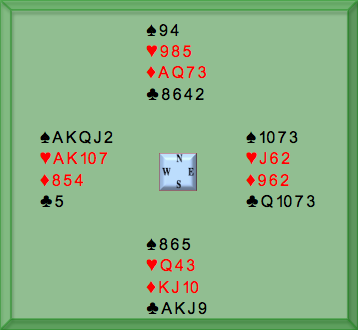
21st Feb – Board 14: Love All. Dealer East.
The hand shown below was strange in that West had to push his side overboard in order to get a good result – and even then there was no guarantee.


When partner opens at the four-level you must not expect a good hand opposite, although at times it can be easy to get carried away. As a rule of thumb give partner an eight-card suit headed by the top three honours  - or compensating values - but with the rest of the cards distributed 2-2-1. If you do that you can see that West has no reason whatsoever to get excited on the hand shown, with the most likely outcome that game will fail by a trick or two rather than there be a slam in the offing. Of course North will spring to life with a 4 bid – which is cold as it happens – and now West will presumably add one for the road, with the likely outcome of playing there doubled. But if West were to act immediately and wrongly, say by wheeling out the Old Black, then North might well keep quiet. 5 would fail by a trick or two but would most likely not be doubled.

Double Whammy


7th Feb – Board 13: Game All. Dealer North.

The featured hand caused headaches all around the room when what started in orderly fashion ended up as little more than a guessing game.


North/South at most tables reached 5 on minimum values and more than once the opposition were tempted to express an opinion that that particular contract would not make. Sadly for them they were wrong, because with careful play declarer will set up the clubs for heart discards thus confining his losers to one spade and one club. But at least one table battled on to 5, a good save as it happens, and even better when it was allowed to make. I can only imagine North started with the ace of diamonds and continued the suit, allowing declarer to draw trumps, take a winning spade finesse and eventually concede a club after chucking a couple away. However I think a club switch should be found because any trump or spade losers declarer might have are not going to vanish, whereas any club losers might – and indeed were. Still it was a tough defence.

As an aside I see that the Law of Total Tricks is vindicated for once. If that concept is new to you I would be happy to tell you, but believe me you don’t really want to know.

Still Waiting


29th November – Board 1: Love All. Dealer North.
North might have been looking forward to getting into the act later and surprising everyone but if so he is still waiting. Mind you some strange people play that an opening bid of 2NT shows the minors….


I guess this hand is all about judgement, the hardest attribute to attain at the bridge table, and the only sure thing is that South will overcall whatever bid East chooses to open, with 4. West will stand on his chair and double and that will cost 800 if East reckons to pass as well. But with an undisclosed suit after an ambiguous 2 opening East will doubtless reveal all and I dare say West should bid the slam, surprised at the turn of events while at the same time being frustrated that the anticipated blood bath will have to wait. 6 is a doddle of course, and 980 is better than 800.

Up For Debate


20th September – Board 14: Love All. Dealer East.
One of the most difficult areas of the game is to have a comprehensive system after 1NT has been doubled, both from the point of view of the responder to the opening bid and the responder to the doubler.


I think East is right to open 1NT here although it should work out badly. (The other option of opening 1 is fine if partner responds 1 because 2 becomes an obvious rebid, but if partner inconveniently bids 2♦ then you are stuck with having to rebid that anaemic suit.) When South doubles 1NT East/West have to know what a 2 bid now means by West. Some play it as a transfer and some play it as natural – a weakness take-out in fact. Put me down in the latter camp and I would have no hesitation in attempting to improve matters with a rescue act. But if West does bid 2 what is North supposed to do? Fine if you play that double is now for penalties but not so good if it is for take-out. The point I am trying to make is that for a really good partnership to function well these matters should have been discussed at length to avoid any ambiguities in the heat of battle. As I play that a double of 2 is for take-out I would have to pass and look sly – something I do to perfection – but I would then expect my partner to re-open with a double, which I would then pass. Two down and 300 to the good guys but only after a lot of system.

Dangerous Switch

19th July – Board 16: East/West Vul. Dealer West.
I think several players sitting East were disappointed at the result on the following hand although any mistake they might have made was punished in the most severe fashion.


You might look twice at that 4 bid from West but it seems right to me, being a good two way bet. (Indeed 4
♠ is cold even without the ace of clubs opposite and bidding to a high level puts maximum pressure on the opposition.) As it happens North has an easy ‘sacrifice’ although it usually turned out to exceed his wildest expectations. What would you lead from that East hand? The king of spades seems the obvious choice but how do you continue when in with the ace of trumps at trick two? A black suit enables declarer to draw trumps and discard a diamond loser on the hearts and a heart switch from East achieves the same end, and although a diamond switch looks dangerous I think it is the right play. Even if declarer has the king he will still not be making unless he has the king of hearts and West must hold one good card at least. Anyway 5 doubled and making was fairly commonplace but it is interesting to note that in a curious and similar fashion North/South have to be fairly quick if they hope to defeat 5, for at some stage South has to switch to a heart from his AJxx holding.

Going For Broke

12th July – Board 7: North/South Vul. Dealer South.
I found this hand the most exciting because it gave West the opportunity to appear truly heroic – or truly suicidal!


Unless playing a strong variety South is bound to open 1NT and West should not look anywhere else than trying for a penalty. East may not like it but with nowhere else to go he should hope that partner has enough tricks in his own hand to defeat this contract, but in fact it is East who holds the two cards that might exact a penalty of 800 points. Suppose that West kicks off with the king of spades rather than the ace. This asks East to give count, and the three would be the start of an odd number, three in this case. So after cashing two top spades West just might consider cashing the king of hearts before leading a low spade! Imagine that! A bemused East would win with the ten and return the jack of hearts and now the defence can come to the first nine tricks. Would I have done that? I doubt it, but it would certainly make for a good dining out story.

Green

7th June – Board 15: North/South Vul.  Dealer South.
When your side is not vulnerable but the opponents are you are said to be at ‘green’ and in these circumstances you can have as much fun as you like. Even three down doubled shows a profit against a making game the other way and if you can deflect the other side from doing that so much the better. On the featured hand East/West are heavily outgunned and their manoeuvres are likely to be ultimately unproductive, but that shouldn’t stop them from trying.


2S is a weak jump overcall, a little on the light side maybe but who’s counting? South has the ideal hand to double, for take-out of course, showing the other major and tolerance for partner’s suit and West increases the pressure by raising to 3S. North might double - for penalties this time - and collect 500, or have a bash at 3NT, which would prove to be an easy make. However the main point to be learned is that even with relatively few points you can still show a profit if you have a lot of trumps, especially at green.

Daisy Picking

24th May – Board 20: Game All.  Dealer West.
It’s nice to have some groovy gadgets for bidding purposes but that doesn’t mean you have to use them come what may and I think the hand below is a case in point. Surely East is worth a shot at game when his partner opens with a weak two regardless of points held or indeed suit quality, which make the Ogust bid of 2NT somewhat unnecessary. We call it daisy picking! Anyway it would be feeble for South not to compete and if West adds one for the road it is hard to see North not doing the same, although 5 is defeated on best defence.


Best defence, however, might be quite hard to find. Certainly if North leads a top spade there are twelve easy tricks but even if North leads his singleton diamond and declarer plays the jack things could well go wrong. To start with South might try to cash a spade or might even underlead the spades in order to put his partner in with his putative queen in order to lead another diamond. Remember from South’s point of view North could easily have started with 109x in diamonds. It would certainly be hard to envisage partner with a singleton diamond and for the record no East/West pair made less than twelve tricks when they were the declaring side.

Fielder's Choice

19th April – Board 9: E/W Game.  Dealer North.
West was faced with a tricky decision on today’s featured hand, but in reality he had fielder’s choice when he could either aim for a large penalty or go for a vulnerable game. And as is so often the case the decision should really be determined by whether the contest is imps (teams) or match-pointed pairs where in the latter case you have to go for the highest score possible.


I’m not a fan of that 3 overcall facing a partner who could not even open but it is what people do and I suppose at the prevailing vulnerability it has some merit. Certainly playing teams I would double - for penalties – with that West hand but 3NT is the winner. (If you bid 3 you have to make sure you have an agreement with partner whether that bid is forcing or not.) Against 3NT North will probably lead the jack of clubs, ducked round to the queen. A diamond to the king now allows declarer to take a heart finesse and the best move from there is to duck a heart completely, hoping that South started with just Kx or KJx, leaving the clubs safe from attack. But even if North did win the second heart (or third if declarer plays of the ace after taking the queen) and plays another club, declarer can counter by not playing the king whereupon the suit becomes blocked. If South passes the opening I suppose West would make some Ogust enquiry, find out that opener had poor spades but good points, and again settle for the no-trump game.

Missing Major

12th January – Board 11: Love All. Dealer South.
There was a great deal of muddled thinking on the featured hand when it came to finding the correct opening bid on the South hand, but the reality is that 1S is the standout bid by a million miles. By not bidding the suit now you stand the very real chance of never mentioning the suit at all, something that indeed happened at several tables.


West
North
East
South
1S
No
2C
4H
No
No
4S
No
No
5H
Dbl
End

As it happened it didn’t matter very much whether South opened 1S or 1D as East is sure to barrage to 4H giving West an easy sacrifice over either 4S or 5D. (Easier over 5D of course, as he might fancy his chances over a spade game.) On a diamond lead and continuation the defence will come to their four tricks for a 300 point penalty, and everyone should be more or less happy!

Perceived Injustice

10th November – Board 2: North/South Vul. Dealer East.
I remember now why I gave up playing pairs many years ago. It was because of hands like the one shown below where a number of perceived injustices can lead to a humiliating result.


West
North
East
South
1NT
No
2C
No
2S
No
3NT
No
No
Dbl
End


The bidding went as shown with South resisting the temptation to overcall with 2S initially, although I am not totally sure why. This would have posed a problem for West who would do best to double and enter 200 on their scorecard although many people play a double as for take-out in that position. However when South passed West not unnaturally employed another well-known convention and hearing that her partner had spades and not hearts settled for the obvious 3NT. But South was having none of it and doubled, even though East was known to have four spades, and I suppose that at pairs if you are shooting for tops this is a risk worth taking. It certainly was in this case as a bemused declarer lost the first six tricks.

Protection Racket

3rd November – Board 14: Love All. Dealer East.
It’s all to easy to go quietly at times when really one should be more pro-active, and if you are in the ‘pass out’ or protective position you should be really sure that you are not being bludgeoned into submission. That was the case for North on the featured hand when in fact he had a sound alternative to staying quiet.

West
North
East
South
1H
No
4H
Dbl
No
4S
5H
5S
Dbl
End
West might have considered a splinter bid of 3S at his first go but it does tend to give a blue-print of the hand if you are not the declaring side and maybe a simple raise to game is enough. (Not showing many points of course because there are so many other options available if that is the case.) Instead of going quietly North should double, essentially for take-out but with high-card points should his partner choose to pass for penalties. South would be charmed to bid 4S and I dare say but West would surely up the ante. At equal vulnerability North is also likely to have one more go and East would close proceedings with a double. OK, I know that E/W can make 6H if they are in it but it is anti-percentage and they won’t bid it anyway! 5S will go one or two off depending how declarer views the club suit, but even two down doubled would show a profit.