Understanding The Problem

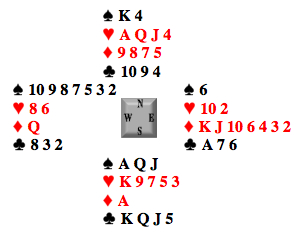
24th February – Board 13: Game All. Dealer North.

There were far too many kangaroo type auctions on the featured hand with South leaping towards what he considered to be the optimum contract without really understanding the heart of the problem. So after North has shown a big balanced hand by whatever methods are used South needs to know a) if all the major players are present, and b) is the queen of spades amongst them. And to do the latter South has to make North think that spades is going to be the trump suit. I think it might go, assuming N/S are playing Benji whereby a 2C bid shows a balanced 19/20 points inter alia:
West
North
East
South
2C
No
2S
No
2NT
No
3S
No
4C
No
4NT
No
5C
No
5D
No
6C
No
7NT
End


I can see no reason why South should not bid 2S at his first turn and repeat the suit after his partner has shown a balanced hand. 4C then becomes a cue-bid in support of spades and 4NT is RKCB. 5C shows three key-cards and 5D enquires about the queen of spades. 6C shows that card together with the king of clubs and now South can count thirteen tricks. Not so difficult after all.

Introducing Lebensohl

24h February – Board 24: Love All. Dealer West.

After partner has doubled a weak two and the next hand has passed, it can prove difficult for the responder to the doubler to differentiate between a goodish hand – say eight points or more – and a load of old junk, bidding because he has to rather than because he wants to. Because of this it is advisable to add the Lebensohl convention to your armoury. This is how it works: with a respectable hand responder to the doubler simply bids his suit, but with a weak hand he bids 2NT, which forces the doubler to bid 3C. Now responder passes if that is his suit or bids his longest suit otherwise. That would clear up any problems on the hand shown above when the bidding might go:
West
North
East
South
2S
Dbl
No
3C
No
3NT
End

3C shows values making the 3NT bid easy to find. If South had the same hand but with few values he would bid 2NT and pass the forced 3C response. The only drawback to this very useful convention is that you cannot bid 2NT in a natural sense, but that is hardly a problem. Just bid 3NT instead! As an aside and not wishing to sound picky, I think East should have bid 3S over the double, in effect bidding to the total number of trumps held. 3S is only one down but the likely upshot is that N/S will end up in 5C, and here a correct guess in diamonds will be needed to make the contract.

Dual Responsibility

17th February – Board 2: North/South Game. Dealer East.

Preemptive action on the featured hand caused more devastation than it had any right to, mainly because the responder to the take-out double forgot that he had a dual responsibility. I think the preempt should be brushed aside and the bidding go something like:-
West
North
East
South
3D
Dbl
No
4H
No
4NT
No
5D
No
6H
End


It may seem strange to make a jump bid in response to the double on just a four-card suit, but you have to remember that partner is prepared for you to do this and will have a contingency plan if he doesn’t like it. (But why wouldn’t he?). Another way of looking at it is to think that if partner had opened 1H you would have made a jump shift to the three level with this eight-loser hand, so surely it merits such a show of enthusiasm now. A bigger worry initially is that you might miss the grand, but for that to be viable partner has to have not only two aces and good trumps but also the king of spades, and if he was that good he should cue-bid in diamonds first. As it is the Old Black confirms that a key player is missing, leaving the simplest of slams to play.

Superhuman Courage

17th February – Board 17: Love All. Dealer North.

There were all sorts of results on the hand shown above and I think it is fair to say that most auctions ended in tears for the declaring side. The only thing that is clear is that North should open with a weak two hearts if that bid is in his side’s armoury, but what happens after that is less than obvious. Sitting East I have a suspicion that I would wheel out a convention that we talked about ages ago…..
West
North
East
South
2H
4D*
No
4S
End


4D is Leaping Michaels, showing diamonds and spades, and West would surely convert to the major suit game. After a heart lead declarer should play ace and another spade, but even so the defending side should get their ruff, leaving declarer to try and make all the diamonds without loss. After ruffing the second heart South is endplayed to some extent and as a diamond switch would be fatal he does best to play the ace of clubs. Declarer will ruff and play a trump for North to win who either has to return a heart or a diamond. But by now declarer knows that North started with four diamonds to South’s two, making the finesse twice as likely to succeed than playing for the drop. If East bids 3D over 2H then West would bid 3NT and after winning the heart lead he should test the clubs first – after all an obliging defender might have started with J,9 doubleton! When North shows out on the clubs a brave declarer might take a diamond finesse against the jack later in the play on the grounds that North probably holds more diamonds than South, but it would undoubtedly require almost Superhuman Courage.

Choose Your Poison

10th February – Board 4: Game All. Dealer West.

North was faced with two grim choices on the featured hand, but in truth he couldn’t win whichever road he took. This was the ghastly dilemma he faced:-
West
North
East
South
3D
No
No
Dbl
No
????


There are several good things about the auction to date, a sound pre-empt – for once – followed by good judgement by East in passing and an equally sound take-out double by South. But what is poor North supposed to do? At one table 4C was the preferred choice but East gave his opinion that that particular contract was not going to be a success, and one can only say that he was right. 1100 to E/W when the smoke had cleared. At another table North elected to pass, which might have been my choice, and hoped for the best, but the best never happened. Or at least it did in a way. I would have thought that once the double had been left in declarer could make an easy eleven tricks because he has been told of the bad trump break. Suppose you get a heart lead. You win in dummy and lead a top club, ruffing out South’s ace. Then surely a trump to the six, pitch a heart on the top club and finesse in spades. Declarer would lose just a trump and a spade. Note that it would do North no good to play the ten of diamonds, as that would suit declarer equally well. So 3D doubled plus two would make, or 1070 to E/W. Not much to choose really!

One Of Those Things

10th February – Board 24: Love All. Dealer West.

I’m not sure anyone got anywhere near the right contract on the hand above, which in a way was a blessing for all concerned as a murderous trump break would scupper any attempt at ambition. And yet I would have thought the auction would very likely go:-
West
North
East
South
1S
No
2H
No
4H
No
5D
No
6H
End


A bid of 2H over 1S always shows a five-card suit at least so West has an easy raise to game in hearts. Being so much stronger than he might be East does best to cue-bid in diamonds and I think that ought to be enough to persuade West to bid the goodish slam. The fact that it doesn’t make is just one of those things and sometimes virtue has to be its own reward. I know some people opened that West hand 1D but unless playing five-card majors the logic for that escapes me entirely. What is the rebid going to be after 1H from partner? 1NT, thus ignoring the best part of the hand or 1S ignoring the basic tenet that no-trump hands should be bid as such as soon as possible. As it happens when the hand did open 1D N/S got into the act and at one stage bid up to the three-level in spades. Had West doubled I think poor South would still be losing tricks.

Supporting Partner

3rd February – Board 19: E/W Game. Dealer South.

If anyone bid a slam on the hand shown above then well done, but I know it was missed at several tables where West refused to support his partner’s long suit. Indeed that East hand is nowhere near as powerful facing a only doubleton heart and although I really do sympathise with West’s lack of ambition I think it is misplaced, because aces and kings lend themselves very well to a suit contract. So I think the bidding should go:-
West
North
East
South
No
1NT
No
2D
No
2H
No
3D
No
3H
No
3S
No
4C
No
4D
No
4 S
No
6H
End


I am a strong believer that when a responder to 1NT bids two suits then game has to be reached, so in the above sequence 3D is game forcing. West can/should support hearts, and now an exchange of cue-bids should enable the slam to be reached. Even with the poor heart break the slam is cast-iron needing as it does only a successful finesse in just one of the red suits.

Guessing Games

3rd February – Board 14: Love All. Dealer East.

A lot of bidding sequences are delicate affairs but every now and again a hand comes along where to some extent everyone is guessing. On the featured hand I suspect few of the protagonists really knew if what they were doing was the right thing, but as usual it was the side that held the spade suit that should have come out on top.
West
North
East
South
No
4S
5D
5S
6D
No
No
6S
No
No
Dbl
End


You may not agree with the 4S opening but it looks about right to me. West has an easy bid of 5D and similarly North is charmed to raise spades but after that nothing is too clear. East should bid 6D, not because he necessarily thinks it is likely to make but because it is to some extent an insurance policy against a possible making game the other way. It would be quite wrong now for South to bid on, on the grounds that he has already said what he has got by his opening bid, and any further action should be left to his partner. As 6S is not going to cost a fortune North should bid just that, again as a sort of insurance policy against losing a possible slam swing. And so par is obtained, with 6S costing 300, but a cheap save against the laydown slam. As a curiosity I see that 7C by East would make unless South leads a heart.